
Writings
Leather Bound Books
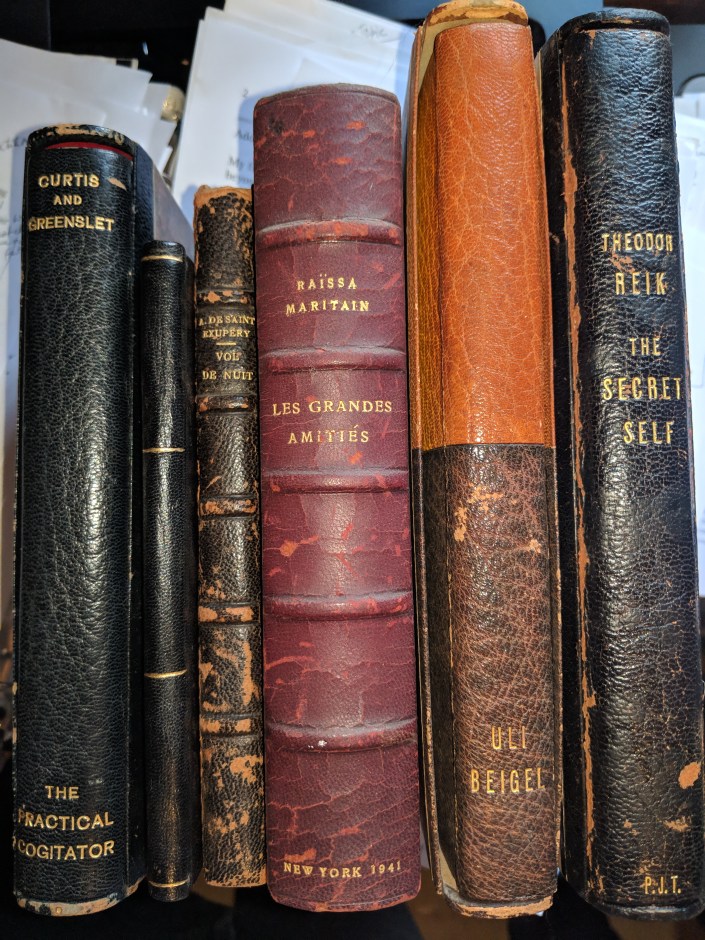
My father built a collection for me of superbly leather bound books. The selection was beyond the ability of my 6-14 year old mind and most of the titles remained unread…until now.
Why did he choose Theodor Reik’s The Secret Self: Psychoanalytic Experiences in Life and Literature to give to a seven year old? He gave me books by Hersey, Salinger, Saroyan, Katherine Butler Hathaway, Isak Dinesen, Jacques Chardonne, Howard Fast, Max Beerbohm, St. Exupery, and other 20th century writers.
Back in the early 1970’s when I lived in Cambridge, Massachusetts and I was a practicing book binder and restorer, I took a bibliography class at Harvard’s Houghton rare book library. Our teacher was William Bond, the head of Houghton. He was of the patrician type one might expect at this formidable university—tall, elegant, gentlemanly from a Protestant stock that formed our nation and its early corporations. Dr. Bond had a rolling cart filled with books he had selected to illustrate his every point. We met in the wood-panelled Keats room, handled rare books, took a short break in the hall to partake of Dr. Bond’s wife’s cookies and then returned with our greasy fingers to handle more books. From him I learned to be a book sleuth.
So, allow me first to report on the visual evidence I found in two books in my collection.
But, I am ready now to decipher this private message my father encoded for me in 1958 when I was ten. I will read his gifts, delve deeper, decode the choices he made, the changes and designs he prompted. I will do this while I translate his letters and diaries; and maybe I will learn something I did not know about him… about me.
The Secret Self by Reik has a copyright from 1952. Included in the binding are the original understated scholarly front and back covers of the original dust jacket. A small ‘–1’ in pencil at the top corner of the first blank page announces insolently that my father purchased it for $1 at a used bookstore. Twenty chapters and an introduction are squeezed into 329 pages. The binder, Gilberte Givel, impressed her name in tiny gold letters on the edge of the inside back cover. At the bottom edge of the inside front cover, my full formal name and the date of the gift are in bold gold capital letters—the accent grave is included, of course: PAULINE JANE TRIGÈRE 1955. The black Morocco leather book has a decorated cover of two onlaid birds—maybe geese—flying off to the right. They are made of various geometric shapes in smooth calf skin—white, gray and black. It begs to be touched, to let one’s fingers graze across the surface. I wonder at the choice of design. Whose? The endpapers are a magnificent shiny dripping of black ink on glistening cream paper stock. And to enclose it all is a box covered in the same paper. Well-made book boxes have this satisfying feeling as one slides the book in or out. The box swallows the book with a barely audible sucking sound. And, pulling the book out feels as if the box is so reluctant to give up it’s precious content.
I must find out why my father chose the book, which chapters captivated him, and also where and what in the text influences those flying geese. It cannot be a random choice.
Without reading an entire book, how does one grasp it’s scope, it’s valued messages, its deep meaning for the writer and also for a particular reader? I searched the table of contents for something that might catch any of my senses. The chapter titles were intriguing, amusing, inviting, but the last chapter, Kleiner Kinder, Grosse Kinder had the strongest pull. It comes from a saying the analyst’s Viennese father used to say: small children, small worries—big children, big worries. I had heard it often before. The author writes of his daughters, then his patients and their children and finally about his own father and that relationship. It is very moving. Since I was only 10 and lived most of the year away from my father, I cannot have been like the problem daughters he describes, but how he views his own father is more to the point. The conflicts that must have evoked something for my father had to do do with his own father—his feeling for that man, his disappointments and how to resolve that. My father was hard on me but even harder on himself. The message I deciphered was his hope that I would use compassion one day to judge him as a father. That was the author’s message. I understood.
Although I cannot yet prove where the design of the two flying geese comes from, I think it may be this last chapter, too. One goose is larger than the other—grosser, kleiner. The smaller one is below and protected by the larger. And perhaps more to the point, their wing tips touch delicately. Parent, child. The smaller one is exactly like the larger one. They are not just black and white; they are gray, as well. It’s not so simple…like our lives.

The luscious blue and green Morocco leather of John Hersey’s A Single Pebble represent water and sky; a small black and gold Chinese junk floats on the front cover horizon. But my father renamed it The Junk, which is also the heading of Part 1. I think I know my father well enough to understand what happened here. He loved to read and he was a serious judge of literature. Clearly, he felt that Part One: The Junk was the best part and boldly edited the author’s title.
All I want to do is hold the book and turn and turn it between my palms. It feels solid, precious and somehow unknowable. Gilberte Givel’s name and mine are gold stamped as, what has become, usual. The dust jacket covers and spine are included. The leather cover design is drawn from the DJ, and this was designed by the remarkable George Salter. Written in 1956 and bound for me in 1958—I was only 10. Could I have predicted that 36 years later, I would marry a man who so admired this refugee book designer that he had created his own impressive collection of George Salter covers?
Two mysteries to decode here. I read all of Part One: The Junk. At first I don’t understand what made my father pick up this book. It is about a young hydraulic engineer (American perhaps) who goes to study the Great Yangtse River. His junk journey into Chinese culture is via the sailors and the captain’s wife. His sense of otherness seen suddenly through their eyes astounds him. He is a stranger learning about his new world, his company and himself. That was my father; he was an immigrant from Europe to America in the late 1930s. He struggled so hard to understand his new world, the people and encountered his continued otherness through their eyes. He wrote to his cousins in Paris that he was marrying America…but by 1958, he had long been divorced from her. Born in Odessa, Russia, he had struggled to become a Frenchman. I am sure they never allowed him that honor entirely and now he was trying again. Of course the book had to be renamed The Junk; that was what was important—this first part. He was reading his own story.
A third immigrant, a refugee from Germany, George Salter also had to make his way into American society. Three strangers meet on one junk on a fearsome river.
I understand.
I have several sections of paperback books that have been torn through the spine; he would send me what he deemed worthwhile and discard the rest! It wasn’t only me; others have shown me their similar oddly curated collections by Sioma.
Mostly, he would send entire books; innumerable people have come up to me to report on or even show me their copy of The Snow Goose by Paul Gallico.
One might feel miffed to not have been the only recipient of his choice book…or one could be flattered to be among the chosen group he felt compelled to send a copy. He reviewed books with his feet and at the post office.
Gilberte Givel… the binder of all these books. It is because of the books and because of her and my 16th summer which I spent with Gilberte in her magnificent Paris apartment, that I became a book binder.
Deciphering Coded Messages
Fifty years ago –as a Sarah Lawrence College sophomore–I competed for and was not accepted into a writing class. It was an ego blow that took me a long time to come back from. Last month I closed my art gallery and now I am turning all my energies to writing a family memoir that spans the entire 20th century from Odessa to Paris and to America.
As often happens, a health emergency reminded me that there are fewer tomorrows than we like to imagine.
All my ‘tomorrow’ projects are waiting for me in boxes, files and notebooks. Somehow, I am the family archivist. My children cannot read the French, Russian and Yiddish letters that tell our family history. Those letters will bring to life their grandfather Sioma, in his own evocative, whimsical and idiosyncratic words. I am searching for the proper archives to house, for instance, the love letters of my mother and her first love while he was fighting in the Spanish Civil War and she was gestating their first child. And so many more things like that.
The memoir I am working on uses objects or documents as prompts. Each object takes me on a journey through my memory and feelings and into the evidence that others have left behind. These artifacts will be chapter headings.
A Journey with Joseph’s Bones, 2017
This parsha has a tremendous amount of important and interesting moments and language to explore. We run from encampment to encampment, Pharaoh’s army chases us, we cross the Red Sea, we are delivered, the Egyptians drown, the Song of the Sea, Miriam sings & dances….and then the grumblings. But this year we read only the first 1/3 and we only get to the troublesome drowning part & triumphalism.
So …I chose to focus only on the 3rd verse we read today, beginning …וַיִּקַּ֥ח מֹשֶׁ֛ה אֶת־עַצְמ֥וֹת יוֹסֵ֖ף עִמּ֑וֹ And Moses took Joseph’s bones with him… I thought I had a unique topic until I discovered whole books on the very same subject. In the Bible, very little is written; but ideas abound in midrash.
The Bible provides four details about Joseph’s bones.
- at the very end of Genesis (Gen.50:25): So Joseph made the sons of Israel swear, saying, “When God has פָּקֹ֨ד יִפְקֹ֤ד taken notice of you, you shall carry up my bones from here.” meaning out of Egypt and back to Canaan.
- Followed immediately with(Gen. 50:26) Joseph died at the age of one hundred and ten years; and he was embalmed and placed in a coffin in Egypt.
- In Exodus, in today’s parsha (Exodus 13:19) we are told that Moses fulfilled the pledge. And Moses took with him the bones of Joseph, who had exacted an oath from the children of Israel, saying, “God will be sure to take notice of you: then you shall carry up my bones from here with you.” That’s our verse 3.
- The final act at the very end of the book of Joshua (24:32 ), the 6th book of the Bible; the first one after the Torah “The bones of Joseph, which the Children of Israel brought up out of Egypt, were buried in Shechem in a parcel of land Jacob bought from the sons of Hamor, father of Shechem, for a hundred pieces of silver.”
Two vital men in our history, Joseph & Moses are featured.
- They both changed our direction—literally and morally.
- One was raised as an Egyptian prince but always remembered he was a Hebrew and became God’s confidant; The other became an Egyptian prince, assimilating and grateful to have forgotten his “father’s house.” That was a quote! They were both bi-cultural Jews…way before we had a name for that.
- One was 80 when he went to speak to Pharaoh; the other was 30 when he was beckoned to listen to Pharaoh.
- They were both 17 when their lives changed dramatically. Joseph was sold as a slave. Moses killed an Egyptian taskmaster and escaped into exile. Moses does, Joseph is done to.
- Joseph’s push-me-pull-you deceptions with his brothers prefigures Moses’s give and take with Pharaoh.
And here in today’s 3rd verse, their names are found together for the one and only time.
__________________________________________________________________________
I would like to explore two topics:
- Practical / the what and how
- Ethical / the why
What were the bones of the Viceroy of Egypt stored in? (He was embalmed, but we speak of bones)? Imagine the Israelites trudging through the wilderness, across the Red Sea, and for 40 years with this container. And only at the end of the Book of Joshua do the bones finally get buried.
Let’s talk aesthetics. What construction do we think of as splendid, truly majestic? We are informed by the culture that surrounds us. Luckily, we have a wide net to draw from. (How about: Queen Elizabeth’s throne room, Bernini’s Baldachin in St Peter’s Cathedral or…the lobby of Trump Towers). But imagine what a Hebrew might know after 400 years of Egyptian residence. Those Egyptian processions and funerals must have been spectacular! And they were the gold standard; and that’s all the Hebrews knew.
And let’s think about how these chests/caskets/coffins were designed and transported. I found plenty of images.

The rectangular caskets were almost always made of wood. The finest—of cedar, others were made of sycamore or acacia.
Gold and silver were reserved for kings, Gilding in gold or silver indicated a close connection to the king
Some were equipped with sleds, to be dragged to the burial place.
After the revelation at Sinai, the Israelites get instructions for building the Mishkan (Tent of Meeting or Tabernacle). But also on the construction of a very special container called in Hebrew aron and translated as ark (not the same word as Noah’s ark: tevah). Aron means closet, cupboard, ark, coffin or casket.
Instructions are found in the Book of Exodus (25:19; 37:6)
It is to be 2½ cubits in length, 1½ in breadth, and 1½ in height (approximately 52×31×31 in). Then it is to be gilded entirely with gold, and a crown or molding of gold is to be put around it. Four rings of gold are to be attached to its four corners, two on each side—and through these rings staves of shittim-wood overlaid with gold are to be inserted; these are for carrying the Ark and are never to be removed. A golden lid, the kapporet which is covered with 2 golden cherubim, is to be placed above the Ark.
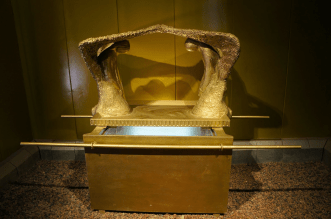
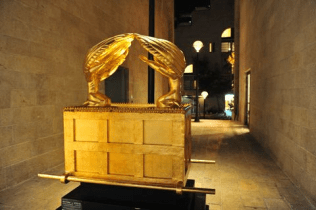
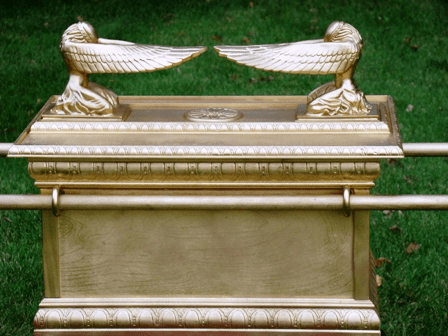
And Cherubim…what are they exactly? Beings with wings. Not exactly angels, but certainly not humans.
In the ancient Near East, wings above a king or even a god serving as protection was common. Tutankhamen’s throne had massive wings on the sides as armrests. The winged sun-disc was a standard iconographic feature in Egypt. In the Mishkan, however, they served either as God’s throne or as protectors surrounding the deity. The Ark of the Covenant was to be the footstool, seat, or podium for God. (Rabbi Dr. Zev Farber – TheTorah.com)
So imagine now, the Israelites after the Sinai revelation are trudging through the wilderness with not one, but two very special containers.
One, with the bones of Joseph and the other, the ark holding the tablets of the law.
One designed in Egypt when Joseph was the Viceroy and the other designed by God!
Let’s leave aesthetics and visuals aside and consider this:
The Hebrews were in Egypt for hundreds of years. They remembered their ancestors’ promise to Joseph. They dragged his aron with his bones with them when they escaped Egypt, through 40 years of wilderness wanderings, through battles for the land under Joshua, and finally buried him in the land of his fathers.
That’s Astonishing…………….I would call that the epitome of Loyalty and Integrity!
Although our text does not mention the “other” aron that is being carried or dragged alongside God’s aron, the Rabbis certainly did take notice. It was clearly troubling and out of that comes midrash.
In Mekilta Tractate Beshallah we hear several propositions.
- The Israelites would explain the 2 side-by-side chests by saying: “one is the ark of God and the other is a coffin with a dead body.”
- Explaining that odd statement they justify Joseph’s aron by saying : “the one lying in this coffin fulfilled that which is written on what lies in that ark.”
- But Joseph died hundreds of years before there were Ten Commandments. The assumption here is that somehow these Hebrews are truly full of reverence; that they have a profound understanding of Joseph, his morality, God’s laws and how these interact.
Meanwhile our Torah text repeatedly tell us of God’s frustration and disappointment with this people. He is tempted to wipe them out and start again with Moses. Do we believe God’s version? Or the Mekilta? Can an unworthy people really be able to revere someone for centuries just because he was such an evolved and moral person? God has no confidence in His people. An entire generation that experienced Egypt dies in the wilderness. Only those who never knew slavery get to enter the promised land. Not even Moses.
__________________________________________________________________________
What does Joseph’s aron represent to these people? What does Joseph represent?
God does not trust them…but Joseph did. They are loyal to the man who trusted them to fulfill a pledge. Joseph did not ask his brothers, nor God, to be immediately taken back home for burial. His father Jacob asked for exactly that and got it. Joseph left this task to the later generations…to a time when God would take note of his people….God’s people? …. Joseph’s people?
Now I am left in a tricky spot. Did we have split loyalties? Is there a contest between following Joseph—a sort of ancestor worship… and obeying this new, demanding God, who claims his role as the God of Abraham, Isaac, and Jacob (more ancestors)? Scholars have explored this divide. Ancestor worship, they argue “was the original religion of Israel before Yahvism was introduced by Moses and the Prophets.” (J. Jacobs, Jewish Encyclopedia)
This is where following Joseph’s bones have led me.
Between the scholars and the midrash writers we can keep exploring.
Do you know….1/3 of the Book of Genesis is devoted to the story Joseph. That’s a lot. Actually there is one interruption: 30 verses– that switch to Judah’s story. The Judah/Joseph parallels are deeply important but not our topic today. Maybe next year.
Genesis ends with Joseph’s death followed logically with the Book of Exodus.
Years of slavery are mostly glossed over.
In Shemot, the first parsha in Exodus (4 weeks ago), we got to hear an unusual message from God that validates Moses by linking him to Joseph. In chap.3:16 God tells Moses to go talk to the elders of Israel and say: פָּקֹ֤ד פָּקַ֙דְתִּי֙ … I have taken note. And with that coded language they know that he knows about Joseph’s prophesy and that he, Moses is the man to follow. Today we read the fourth parsha of the Exodus story. I focused on one line that had nothing to do with the bulk of the parsha. It is a tag line that glimpses back to Joseph. We will get one more glimmer of Joseph at the end of the book of Joshua. Just glints that remind us that ….there is a sub-text …that seems to have completely disappeared.
Have you ever wondered why we have a pentateuch and not a hexateuch? Why 5 books and not 6 to read over and over each year… Our story is left hanging at the end of the Torah.
We are forever leaving Egypt and never getting in.
But after Joshua…
and after we bury Joseph…
we have arrived.
Feet, and What They Stand For
At the base of it all are my feet.
They hold the whole human endeavor. They carry the burdens of human life. They see us through long waits, hurried errands, pregnancies, striding runs, overweight years, posing just so, standing, and shifting back and forth….and waiting and waiting.
I only think of them when they hurt and when I was young, I don’t remember them hurting…except perhaps when I bought a pair of shoes that I thought were so pretty. Two days later I was sorry, but I didn’t know. I thought it was that way for everyone. I assumed that everyone had the same problem. Anyway, we girls kept buying pretty shoes… and felt just like everyone else or momentarily special, perhaps a little better than everyone else.
Any sensible child would have had maybe 1. 2 or maybe even 3 pairs of shoes at the bottom of the closet. I think my collection grew larger. It would have been useful to have an adult or slightly older friend say to me: Do you really need those?”
And then I went to college and probably dragged all my shoes with me. And then I got married and certainly dragged all my shoes with me. Along the way I collected more. And of those a certain percentage never quite fit.
I was in my early 20s then. Sneakers were only used in sports and I was not sporty.
We moved to Israel and then, I and my daughters moved to the kibbutz. The shoes came of course, with everything else I brought with me. That was the time and place when I wore espadrilles. Those Mediterranean peasant shoes are not known for giving much support. I loved them. I wore them all the time and everywhere and they went with nearly everything I wore. What does one wear on a kibbutz, after all.
When did the foot pain begin? It’s not the kind of thing I would’ve put in my diary. And I didn’t have a diary anyway. When do things start to go wrong in our bodies? We don’t keep track of that. There comes a time, and I think I am there now, when we get old and when we have so many ailments or issues that we have to write it down. We need to be able to report to a doctor. How do I remember that my bowels were off the other day…Oh, it was when Jonathan came to dinner, so it must have been Monday night.
I feel I am shifting my weight back and forth between my left and right foot. I’m hedging. I am digressing.
I think it must have been some time in my 50s when the pain in my feet became disruptive enough that I started thinking about going to see a podiatrist. But it was not until a decade later that I actually made an appointment and went. Another world, another specialty. I felt had gone to some voodoo doctor. I don’t know why I say that exactly. He must have had a medical degree, but I felt like I was dealing with somebody who is more like a shoemaker. Shoemaker’s are real healers. Oh, that was a pun and here is another fitting one: shoemakers fix souls. Surely if “cleanliness is next to godliness,” then well-fitted shoes make for contented souls.
I was a shoemaker for awhile on the kibbutz. Rather, I was a shoe repair person. Looking for a place to store all my no-longer-useful-bookbinding-tools, I was steered to the former shoemaker’s atelier. He had died and shoes were now collected and brought to a local town for repairs. The tools seemed similar and I volunteered for the task. They laughed at the administrative offices but relented when someone recalled that a kibbutz down the road had a woman shoemaker. Gender was the issue! I took a class or two and restarted the shoe repair industry on my kibbutz of 800 members.
The podiatrist has interesting tools: heavy-duty clippers and scissors, an electric dremel, and tiny scalpels. They sit at my feet on a low stool like the shoe salesmen of yesteryear. More like a service industry then a medical specialty.
My first podiatrist died shortly after my first visit. The second one was offensively like a salesman pushing some surgery as if were the latest fashion. The third one lost me half way through his plans for orthopedic inserts when I had to deal with cancer surgery and chemotherapy instead. The forth one was so awful, I actually left the office in mid-session. Recently, I cautiously but with serious curiosity accompanied my husband to the free podiatrist available through our town’s Senior Center. Out came the large hand clippers, the tiny scalpel, the dremel. He did his work on my husband’s feet. He seemed okay, so I allowed him to look at my feet and even do a little treatment. The foot stand he used to prop our feet was made of wood and old brown leather. It might have looked at ease in an old shoe store or even a shoemaker’s shop. He did not wear a white medical jacket; he might have just been some handy guy who came in off the street. I went home and looked carefully at his work. Not so impressive close up; not sure that I will return…not now. Maybe when I can’t take care of myself…when I have lost my independence.
I cut my own hair and have since my early 20s. I do my own pedicures on the bathroom sink. I have learned how to deal with painful ingrown toe nails and all the other indignities of aging feet. Often, as I prop my foot up on the edge of the sink, I wonder how long I will be able to do this. What happens when I can’t bend so well, or see so well, or handle the clippers so well? Well, there is the Senior Center guy.
In truth my first podiatrist was my father. When I was little, he cut my toenails. He was very good at these kinds of things. He took superb care of himself. I remember accompanying him to his barber at The St. Regis Hotel in Manhattan. I can still see the bent over woman on a stool at his side giving him a manicure. I assume he got a pedicure, too. He supervised my toilette, making sure I was always well-groomed. I groomed my children too, but I, personally, never went for pedicures, manicures, or hair cuts.
Since the chemotherapy, I have peripheral neuropathy. I had never heard of such a thing. Since 2014, I have learned to live with it. The harsh chemicals that kill cancer cells affect negatively the nerve endings in the peripheral parts of the body. Not everyone experiences this, just as not everyone loses all their hair or fingernails and a few other unpleasant things. My feet had to relearn what the floor feels like, how to perceive what part of the foot I am leaning mostly on, whether my body is properly balanced over my two feet. At first it was like walking on massive cotton balls. Now it is my new normal. I learned that coldness will invade my feet and stubbornly not leave; they will be so painful in a whole new way I had never conceived of. Like some caricature of an old person, I work at keeping my feet warm now. Many people with diabetes suffer this; and goodness, there are plenty of people—old and not so old—with whom I can commiserate and exchange anecdotes.
Today I went for a treatment called reflexology. The practitioner fits somewhere between a masseuse and a podiatrist. I have no idea how it is viewed in the medical world and hardly care. If the medical profession can endorse what I have seen in the world of podiatry, I don’t value their judgments on whatever reflexology is or isn’t. It was wonderful. She spent a long time “thumb walking” up the bottoms of my feet, massaging and pressing every part of every toe. When I left with my two sets of socks and my heavy boots, I could feel—not feet, but rather toes—ten of them. Asked later how I felt, I quipped: like multiple orgasms in my shoes.
I don’t buy shoes that pinch or deform the foot anymore. That damage has been done. I live with it full-time. My shoes are now mostly sensible. The few high heel shoes I have kept are stored away in a little-used closet. I keep them just to be sure that I have something to wear with those dresses that do’t go with espadrilles, clogs, sneakers or boots.
3 Fables
I found myself nearly crying in the naturopath’s office. She had just complimented me about the amount of important things I had done in life. My response was sudden, sharp and certainly strange. Even I thought that, as I observed the scene then and in retrospect. “No,” I insisted. “I have not accomplished anything; not the architecture career I started…the organizations I invented have all three disappeared… two bad husband choices…never rich enough to be really helpful to others…and my visual skills…no significant “body of work.” In one fell swoop I demolished myself. Immediately, I felt foolish and soiled. But when I reached the car to go home, I knew that I believed these criticisms and I was sad and I needed to think about this state of mind.
A cancer diagnosis can sharpen one’s wits; can refocus the eyes on the clock, the calendar…what is left undone, to do, to fix. The measure of one’s life is checked repeatedly and sometimes I found myself wanting. Regrets can spoil any good day if I let them in. My dreams are full of anxiety of tasks that must be done. I wake at three in the morning and a roiling list of obligations keeps me awake for hours.
Today, I came back from the hospital not having had the drainage from around my lungs that had been scheduled. It was my decision, but the whole experience was wearing. In the car I was beyond exhausted. I rested with my eyes closed while Ken went into the supermarket. And on the way home I fell asleep and when I got home I went back to sleep—in my bed this time. When I woke, I saw clearly. Three stories came to me.
The Story of Bill, the Nurse:
The nurse who greeted us today was a stocky guy with an open face and ready smile. He escorted us to one of the examining/procedure rooms. Ken sat in the only chair. I stood and paced and then sat on the edge of the bed. Bill stood too, but took his seat next to me—right next to me and swung the rolling computer screen in front of us to check on my file. Side by side is so friendly, even kindly and cozy—not my usual experience of nurses. Eventually, we got to “How are your bowel movements?” We have fun being silly and serious and even flip with this lowly topic, when suddenly, he scrambles to leave the room. Without missing a beat, I joke about his being very impressionable. He laughs and we return the laughter. When he comes back, he runs down his list of questions. “Did you store your own blood for a transfusion?” “No,” I say confused. “I don’t think I ever had a transfusion and I don’t remember ever having had a discussion of storing my blood.” “Oh, it must be an error,” Bill says casually as he deletes that from my file. “There are probably more,” I volunteer. We were enjoying the time with Nurse Bill. At some point, I ask “Don’t you need to see my ID?” He chuckles and acquiesces as I hand him my driver’s license. Then, he says unexpectedly, as he looks down at my ID in his hands, “I hope you are not the jealous kind, Ken, but your wife is beautiful. Just look at those cheek bones!” More laughter.
We talked of many things. His daughter who is studying textiles in Maine; and the older one who is starting off her career in museums at the Quadrangle in Springfield. It went quickly from subject to subject—some medical and some social. We were waiting for Dr. Grassi. There was a schedule mix up and it was the day before Thanksgiving. Buying time perhaps, he notices my sweater, says that his daughter would find that pattern interesting. “I made that!” I say triumphantly and explain my salvaging efforts—cashmere with holes, camouflaged with needle felting. He is animatedly interested, explaining the custom in Japan of letting repairs show, like a silver seam in a broken vase. We are baffled by the unexpected direction of the conversation.. I have a poem about just this topic. I promise myself to bring it to him on Monday when I return for chemo.
Ken, reflexively, hands me his business card, to which I add my name on the reverse and invite Bill to bring his daughter to visit me to talk textiles—indeed both his daughters—art and textiles.
At one point Bill and others are looking for Dr. Grassi. Not in his office, not answering his phone. I suggest he may be in ‘the smallest room of the house.’ Bill finishes the quote for me “I am sitting in the smallest room of my house. I have your letter before me, Sir. In a moment it will be behind me!” he identifies it as Voltaire’s. Later I search and find it ascribed to a variety of witty European writers. But in that moment, Ken and I stare at this phenom who is my nurse…. who exists down here in the bowels of the local hospital?
When we leave, he actually escorts us to the elevator…a long, long walk…as if he were walking us to his front door after a lovely evening visiting his home. He held the elevator door open with his body and as I walked in he gave me an ample hug. I gratefully accepted.
The Story of Levi, the Moldavian:
Ken told me that yesterday a man he barely remembered rang our doorbell. It was clear the man wanted to see me, not Ken. He was Levi, the Moldavian who had worked for UPS helping during the winter rush at least 5 years ago. I needed prodding to remember him. But, clearly the Moldavian remembered me. He kept looking over Ken’s shoulder to see if I was there. I had made a connection for him with the only other Romanian speaker I know. We had spoken of life and immigration and our own parents’ stories. He remembered our kindness and wondered oddly if we always are kind to strangers? Would Ken help him, he quizzed strangely…. by lending him money? giving him a car?…and a few other less remarkable questions. He is a devote Evangelical Christian and wanted to know if we are so generous because we are Jews. Incredulous, I asked Ken to repeat this.
He had returned with one of his three children, his American contribution, but perhaps mostly to check on us to see if we were real and still there… the way in the late 1980’s I used to check that a file was really saved when I hit the computer’s ‘Save’ button… the way we scan a bookshelf with our fingertips to make sure a favorite title is still there and briefly reabsorb its tale. Ken said no to the car but gave him a book for the 3-year-old standing patiently by his side. Perhaps he had just come to show us his progeny.
Ken awkwardly waited for him to say goodbye. The man lingered glancing again inside. Sensing the unfinished quality of the visit, Ken asked for his phone number, assuming he wanted me to call him. I don’t know where that number is now. Unfinished will remain unfinished.
The Story of Eloise:
A few days ago, we were at the supermarket in Northampton…each of us on our own, collecting items. I was in search of Quinine water walking along the large back aisle, the one with dairy, meat and fish. I was feeling good and in a happy mood. Wrapped in my wool shawl, I had tossed one side back over my left shoulder. A woman some 10 feet away from me, walking toward me, says suddenly: “You look fabulous!”
I don’t know her; she doesn’t know me. I smile and say “thank you.” We stop and revolve around each other and start a lighthearted conversation that focuses very quickly on her name, Eloise, and the children’s book Eloise at the Plaza. We each claim it as one of our favorites, chatting about our favorite scenes and special pages. I ask what the nanny’s name was and we agree that it was just Nanny.
There is no agenda. She blurted out a compliment and I responded kindly and we each felt—she in particular—a momentary kinship. She asked if she could hug me. We did; two strangers hugged near the packaged ground beef. We chatted more. I told her I had a favorite book with my name in the title too: Impunity Jane. It’s about a little doll stuck for generations in a dollhouse until a boy steals her and she gets a life of wild adventure. I asked her son’s age. Twelve, she answers. I acknowledge and say it might work for him. He’s a boy, she emphasizes. It might delight him, I emphasize. And then Eloise asks if we might stay in touch…
Two years ago, I might have agreed and exchanged phone numbers. And with that either start a whole new line of friendship or something else that verges on an obligation. Today I thought quickly and realized I did not have the time or energy to include her in my story any more than this charming encounter. I smiled, paused, and took my prerogative of elder.
“Could you be satisfied with just this?” I asked gently, still smiling. She nodded yes, and took another hug.
We parted down the aisle in opposite directions. I looked at her figure as she walked. Her head turned back to look at me. Awhile later, at the cash register, Eloise pops her face in front of mine and blurts out “I forgot to ask your name!”
“Impunity Jane,” I smiled back.
“Oh yes,” she said and she was gone.
Three messengers came to remind me of my lifetime full of meaningful human interactions. I smiled gratefully. I could be satisfied with just this.
To Hear One’s Voice
Ken and I spent the morning sharing readings and ideas.
He cut out an article to read about an Australian woman writing about her grandmother who was a refugee from wartime Europe in 1939… and of being the guardian of her grandmother’s jewelry and archives. Burglars got the jewelry. The archives remain.
I too have archives and artifacts that I am responsible for. I am struck with the dilemma of being the hinge generation. In her case, the generation that experienced the Holocaust are nearly gone. This woman in the article has inherited an imperative to represent this past, to prevent this history from crystallizing into myth. How does one do that?
I think, oddly, about how making bread or a holiday recipe is a way to connect with family history. My mother taught me to do this in such a manner and her mother taught her, etc. Also, at the Passover Seder we tell the story of the Exodus from Egypt and we say “our fathers told us this.” And, of course, their fathers told them, etc.
I then read to Ken a passage from a book I was reading about the power of liminal moments. These threshold moments are soul moments, the author says. I think he means that they are crucial to who we become. The door opens; the door closes; the hinge is both here and there and in neither place. It facilitates that threshold moment. Isn’t that we we are talking about?
And suddenly, out of nowhere, a phrase comes to mind: “C’est ridicule.”
This was my father’s judgmental catch phrase. Sometimes it was aimed outwards at life’s clearly silly, ridiculous events. But sometimes it was aimed at me.
Ken and I went on talking and sharing ideas. They flowed off my tongue. I felt the ease with which they formed themselves into cogent sentences as I heard myself speak. Why, I even inspired myself! Then I knew what he would say: “Go write these thoughts down. Take a moment.”
But, I knew I could not. I explained that speaking rather than writing brings out something…like the creative tension of being onstage and having to produce sound in a composed and persuasive manner. The instant, the very moment of reacting with words, to whatever is being said, read or presented, is potent… and then lost.
I added that there are two levels I can discern.
One, is to have an insight and to think: “Wow, that was really sharp, interesting, and even useful.”
And, two, which I hesitate to share with anyone, is that there is a secret place in me that wishes for a larger audience–perhaps to be able to help others with my experience and insights… or less humbly, to be known as someone with certain …je ne s’ais quoi… wisdom?
Ah ha, this must be where “C’est ridicule” comes in.
I can’t seem to get from the deep, interesting conversation to placing those same ideas on paper. Why is that threshold, that liminal moment so hard to cross? Enforced modesty or humility has its price. Don’t be ridiculous, Jane. “They all know better, are smarter, are well-known…who are you to speak at all?” This old message took it’s toll. Way back in high school, in college and even later, my knees would visibly, and even audibly shake as I waited my turn to ask a question in public. Time and repeated experience let me observe that my questions were valued, useful, even hoped for.
But, here I am unable to recreate on paper what flowed from my brain to my lips just an hour ago.
I know, it’s enough that I had the thought. The thinking of the thought is enough, isn’t it? Ken heard me, and importantly, I heard me. Speaking aloud is so definitive. Thinking can be so amorphous. Forming words, forming sentences… syntax has a force that is underestimated by everyone. But when I speak, I can see whether my words have reached their mark, have changed a mind, have struck a note. Who even thinks about what I just wrote?
And now, the years have collected and I sense how my words need space on paper to be recorded and read later. We all are the hinge generation. Only we can transmit what we “know” or have heard from earlier generations. If I have something to share, it will have to be on paper, because my time is… well, not timeless. I had forgotten. No, I had never even thought of that. I will not hear my voice in future years—not the actual voice. It will be someone else’s voice I do not hear. It will be in the voice of the reader. And there is a strange, strange thought.
I will have to write about it, of course.
Face to Face with the Image of God
Everyday, Hanna needed to go out into the world and encounter some people… any random people. It did not much matter who. The possibility for interactions, for dialogues, for giving joy, or praise, or even advice… well, if there was such a thing as a pregnant pause, then surely there could be expectant possibilities. These were all that is needed… that, and a little bit of boldness.
Hanna had reached an age when she could get away with things–things she could not do as a younger woman. In her 60s, she could directly, abruptly, amusingly speak to a random couple on the street, at the market, or leaving a movie theater. In her 30s, 40s, maybe even 50s there was this… what shall we call it… some psycho-socio-sexual something-or-other that would prevent her from doing exactly the same thing. Freedom. She had freedom to act freely. On the other hand, she was able to imagine that there might be an upper limit to this privilege. As a 90-year-old, she might elicit a dismissive reaction: “Oh gosh, here comes that old nut! Let’s get away. She tells the same old story every time we meet her!”
But if that were the case–if she’d become dotty–then she probably wouldn’t mind or even notice. She’d chirp, “Every day, I meet the nicest people,” …over, and over again.
Find more people to smile and laugh with. That was Hanna’s goal. This is what fed her, gave her hope and strength and kept her resilient and happy. She had finally learned to take care of herself, and how to properly do so. She was no longer fitting herself into the busy schedules of everyone around her. It was okay to not get her “to do” list done. Okay, to go lie down and rest; okay, to nap today–and yesterday. The possibility of gleaning some joy, an insight, yet remained.
Tonight, Hanna might dream; she might recall the dream; and perhaps that dream will help her resolve some anxiety, some unfinished worry… but tomorrow, in the bright new day, she will engage life again, and find more random people to meet face to face. If we are made in God’s image and God’s presence is manifest in the face of the other, she cannot be too selective. That presence must be in an anxious face just as much as in laughing eyes.
Last week, she noticed how big her grandson’s feet had become. “Wow, looks like my shoes might fit you!” she declared. So he tried them on. “I feel like I am wearing Omi’s shoes,” he said, bemused. Hanna wasn’t sure if that was a good, or bad, or neutral statement from an 11-year old. Maybe a bit of each.
Then she remembered the day before her wedding, feeling that she was walking her mother’s shoes. As she crossed a parking lot she heard the clop clop of her mother’s high heel shoes. She felt that she was inhabiting her mother’s actual shape. So she said out loud, but quietly: “Hello Mother. Thanks for being here with me today. I wished you could be here… and so you are.” She did not often think of her mother, nor wish her presence, but as she grew older into the freedom to act free stage of life, her mother came to mind more often. In fact, since she reached 63, the age of her mother’s death, she often thought things like: “She would have been interested in this or that development,” or “Who would Mother have voted for in this election?” or “Would she have mellowed and been easier to be with at this age?” and, perhaps, most wistfully: “I wish you were around, Mother; I’d like to talk to you about something.”
Hanna’s mother was a bold woman. Bright, brave, witty, beautiful, but something was not right. Too many quarrels, too many directions, too many husbands, too much alcohol. Not a happy person. It took Hanna many years to appreciate her mother, to understand her, to admire her, and to feel compassion for her. A wonderfully stranger idea came to her. “Wow, the person I have become could easily have been a good friend to her, encouraged her. I could have made her laugh.”
And with that, to herself, Hanna laughed.
Fixing Everything
I am always fixing things.
Prying open something with a screwdriver; applying glue; oh that reminds me the veneer on the leg of the dining room table needs glue. Quick before it falls off. The vacuum cleaner must have banged it.
Shopping bags—paper and plastic—are dropped and forgotten. Inside are the materials necessary to fix something. Who remembers? Is this me in my dotty old age? Surrounded by bags full of unfulfilled projects!
Would I recall what project was intended if I peered into one of these bags? Or conversely, if I resolved to finish a particular project can I find the bag with the needed materials?
Ha’azinu, 2015
On this Shabbat directly after Yom Kippur, I would like to loosely weave together three themes that have touched me during these recent holidays. I hope you will see the link. And… the culmination is today, with the death of Moses.
On Yom Kippur we read from the Torah (Leviticus 16) about the role of the High Priest. About the 2 goats and the sacrifices and about what happens in the Holy of Holies once a year.
The High Priest will bathe and wear a tunic with breeches, sash and turban – all in white linen. He will go alone behind the parochet, the curtain.
There, in the Holy of Holies are the Stone Tablets that God gave Moses. They are in the gold-plated wooden chest—the Ark of the Covenant
But lest he die from such a sight, from such proximity, the High Priest will throw incense on God’s fire – and cloud his own view. What is it that he should not see? The kaporet, the cover of the golden chest? Kaporet? Why is this like kapara, or kippur. What does the root Kaf, Peh, Resh mean?
Rashi explains kaparah as wiping out
Ibn Ezra as hiding, covering
Rambam as ransom for a soul; atonement
Kippur is often translated as Atonement and Kapara as Sacrifice
The text says: “He shall then slaughter the people’s goat of sin offering, bring its blood behind the Parochet/curtain, and do with its blood as he has done with the blood of the bull: he shall sprinkle it over the Kaporet/cover and in front of the Kaporet/cover.”
Kaporet (Kaf, Pey, Resh & Tav) ……..Parochet (Pey, Resh, Khaf, Tav)
Same letters; different order.
Behind the Parochet is the Kaporet
I understand that something terribly important happens between the two—
between Parochet and Kaporet:
But what?
It is a permutation of letters, but a reversal that is transformational…that is, in fact, redemptive.
__________________________________________________________________________
The second theme is the 2 goats
One is sacrificed by the High Priest as a sin offering.
The other goat, the scapegoat, is burdened with all the sins of the people and sent off to make expiation into the wilderness, to Azazel (whatever that is. Our Rabbi spent time on Yom Kippur exploring this in his sermon).
Rituals are powerful. Perhaps the ritual of the scapegoat inspires Jews to repent because it symbolizes that we can divest ourselves of past sins. The goat is left standing alive but sent off to possible or probable death… but we will not witness its death in the wilderness.
And, so in this week’s parshah … I imagine Moses… standing… high up on the peak—that is, on Pisgah. Is he perhaps the 2nd goat and is he also the High Priest pouring out the past and future sins of the people? His poem or song describes what will happen to us when (not if) we betray God.
It’s a history lesson—a harangue—an accusation—a warning—a witnessing …and a promise of God’s redemption. He speaks about God …and for God.
The last line (verse 43): ve’khiper admato amo translated variously as:
God will “cleanse the people’s land.”
or “appease His land & His people.”
But admato may be a scribal error for u’dmaot
Meaning, therefore, He will “wipe away His people’s tears” (not land).
Cleanse, appease and wipe …are all used for the word= khipper…which we know as atone or sacrifice.
Are the sins poured on our heads or has Moses taken them on like the goat? Is he somewhere between parochet and kaporet expiating our sins.
__________________________________________________________________________
And later, on that very day Moses dies somewhere in the wilderness…
Much has been made of why he is prevented from coming into the Land…But I see this moment in the story as a sacrifice—a not so willing one.
14 years ago I wrote this midrash:
(Moshe and God on Mt. Nevo: a Midrash on Deut. 34:4-6)
So, the day was ending, and Moshe climbed the narrow trail to the other face of Mt. Nevo. Earlier in the day, at Pisgah, God had shown him the entire Promised Land and all that would befall Israel in the future. He saw more than he cared to.
So his thoughts turned to the past. He thought of Avraham who also climbed a mountain…that time, to sacrifice his son Yitzhak at God’s command. But God intervened and substituted a ram. “Maybe God will ……” he half suggested raising his eyebrows as if in conversation… and one hand opened to express the possibility.
He thought of his own sons, and wondered if he could have withstood such a test. His throat tightened around a flood of memories…so many recent deaths…
As he continued his climb, his thoughts wandered over the years. He recalled protesting to God that he was “not a man of words…that he was heavy of mouth and speech.”
“But, I suppose I did alright these last 5 weeks… teaching the people…with God’s help, of course” he added quickly, for he remembered God answered him then rather impatiently:
“Who makes a mouth for man…Is it not I, Yod-Hey-Vuv-Hey. So now go! I shall be with your mouth and teach you what you should say.”
Oh yes, he remembered well, and everything. He had pleaded with God so often—but he knew that no plea would change God’s decision now. He was not going with his people across the River Jordan. He would die here. Certainly, it was not because he had no strength or no skill. …for he certainly had the ability to persuade… even God. But, not this time.
The evening sun stood sentinel. “I understand,” he said suddenly out loud, startling himself.
The Man of God stepped surely over stones and brush to reach the place — haMakom… the very place where God would meet him, as promised.
“Hineni. I am here.”
“Friend,” said the voice of God softly, “I, too, am here.”
Moshe knelt.
“You are my faithful servant,” pronounced God, raising Moshe’s already lofty status to that of Servant of God! A servant, after all, is permitted to enter the inner chamber of the king. Moshe would surely see now more than the afterglow of God’s passing presence.
Even kneeling Moshe was dignified.
God enveloped him and placed His mouth on Moshe’s mouth and reversed the act of creation. Yod-Hey-Vuv-Hey had breathed life into Adam’s mouth.
Now, He held His Godly breath and Moshe expired.
God carried Moshe’s body down to the valley and buried him Himself.
And that night, we are told, I-Am-That-I-Am was heard crying on Mt Nevo.
…
Well, a lot has happened to me, as you can imagine, in the last 14 years.
Which brings me to the next and last theme.
During these Holy Days we did a lot of remembering of our parents, our teachers. I thought about how hard it is to separate from them. To keep them close (in love and in hate) ….and to become separate—to become oneself.
I thought about the admonitions, criticism and other, shall I say, “poems” my father aimed at me and I wondered if I was any freer from perpetuating these “sins” than the Israelites were after hearing Moses tell them how they would fail repeatedly.
I thought about the role of parent/teacher—like Moses, like my father and now like me.
I am not sure that any of us know what we are doing with our warnings & predictions if not insuring that they will indeed happen.
But I do know that God loved Moses… and retired him from his job as father/leader/teacher in the only way possible. Moses died and there is no grave to visit, to mourn, to protest and cry at, or even fight over.
The Israelites had to make their own way with their own mistakes…just as I had to & just as our children must… in spite of who our parents were… but also because of who they were.
__________________________________________________________________________
The last few days have been filled with remembering: of sins, of sacrifices, of deaths and then… then atonement.
The Baal Shem Tov said that “remembering is the secret of redemption.”
As we come back to the mundane world from our own personal Pisgah experience…
…from the intensity of the mystery between Parochet & Kaporet…
…from our restoration through reversals & teshuvah…
…from cleansing and appeasing and wiping away tears…
…May we go forward guided by the memory of a courageous Moses and the Torah he taught. On his yahrzeit, may his memory be for a blessing.
This year, Moses will be the first guest in my Sukkah.
Kibbutz Woman
It was mid afternoon as I entered my kibbutz; the motor urged me up the hill and I parked the old pick-up truck in front the members dining hall. No one was around; it was rest time for some and others were still at work. Zurichka eyed me from a distance as he advanced in my direction. Stocky, self contained, and dressed in blue overalls, he had a modified swagger that was common among the men here. He had never spoken to me, but he, like everyone else, had taken in and made their preliminary assessment of the new arrival: a freshly divorced woman, an American immigrant from Jerusalem and her two pretty daughters. I also knew how to drive a car—and a stick shift, at that. Only one other woman on the kibbutz could do that.
I could sense Zurichka distilling his thoughts to the essential words only.
“Did you just come from Jerusalem?”
“Yes,” I answered.
“Did you come up through the Bekaa? (The border road along the Jordan River.)
“Yes,” I repeated.
He took in the scene and pronounced: “At hevremanit.”
He didn’t wait for a response; there was none to make. I repeated the phrase to myself not sure yet what exactly he had said. I thought, but wasn’t sure, that I had been complimented. I took the phrase to my relatives and they confirmed what I had settled on. A “hervreman” is one of the guys; an okay fellow. “Hevremanit” is the rarely used feminine form.
I had received the ultimate Israeli compliment from a kibbutz old-timer.
 Jane Trigere Art