
Writings
The Table Leg
She sat quietly under the table. Her mother and the 3 other female canasta players eventually forgot she was there. She held her breath as long as she could each time, in case they should suddenly glance to see if the children were about. Holding the table leg that was unencumbered by knees and hand bags she followed the curved line to the claw foot. Above, the voices droned on about local gossip interjected by canasta “calls” and she let her mind wander into imagination, into the lion’s cage, no, into the jungle where she lived within the protective warmth of a lion clan. She nuzzled the lion mother and felt safe at last. The purring of many cats filled her head and let her be… without thought, without worry, without words.
“There you are! Oh dear, the child has been under the table this whole time.”
She is pulled out by her arm and made to stand on her two human feet in the full glaring light of amused and reproachful human eyes. The busy chatter of women worried about what they revealed during the last hour catches the wind and seems to float out the window into the streets of Buenos Aires… or New York, or Kansas City.
She hops away to play in her room. Hopping is what is expected of a 4 year old. They will not think twice about her. Their voices return to a rhythm that has forgotten her. She would mull over what she heard and not understood. How did she know she was not supposed to hear certain things?
The Fuzz of a Peach
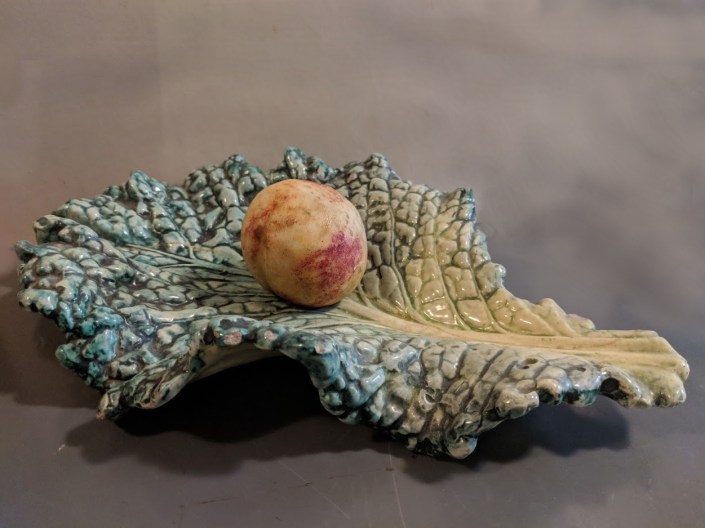
Holding this peach in my hand today, weighing it, remembering back to a time. To a time
when it sat in my father’s library in Manhattan’s upper east side. When I was a child, the peach used to be fuzzy, but it isn’t anymore. It was always heavy as a stone. It is stone or something quite heavy like marble perhaps. This peach has always lived in this Majolica plate…a wavy curly green leaf of chard. It had suffered a large break and now sported a clumsy glue repair. I could not recall if that repair was part of my memory. So many hands had fondled this nearly perfect object. Just as I had. That peach was worn out. It had lost its fuzz–like old balding men…like my father.
A few years ago, on a visit to California, I saw the plate and the balding peach again in my father’s widow’s home. I saw all my childhood there. I had grown up surrounded by furniture from France; an ornate mirror and writing desk from my grandmother that eventually migrated to my father’s apartment. Two heavy cast iron Charles X chairs, a brass heron standing lamp. Paris, New York and now, Los Angeles. “I have left you all the furniture in my will,” she explains matter-of-factly. That was nice, but she is only 12 years older than I am. Who says I will outlive her? How soon am I likely to get the furniture that holds my entire past?
She did not react to my expression of eagerness about the strange green plate and its old
peach. She did not offer them to me. She didn’t say anything like “Oh, would you like them?” She simply started talking about something else. And so I instinctively stopped hoping and moved on to her next topic. Where did all the fuzz go to?
Several months later, a package arrived and in it I found the plate and the peach.
They have stood sentinel together for decades. Their life together was much older than mine. And now we are all here together one last time.
I weigh the sad peach often in my hand and ponder the lost fuzz. I start this family memoir with a certain wistfulness, a bit of trepidation, unsure of where the journey will take me. Witnesses to the story die and the memories die with them. Objects remain… stubbornly, remarkably. How shall I solve the puzzle?
How shall I glue the story back together?
Recovering memories is like trying to put the fuzz back on a peach.
Artifact by artifact I will meander back in time and place.
Each item sparks a variety of strands of memory.
Patience
Being a patient is one who suffers.
Having patience is having forbearance
One learns to shoulder one’s burdens. That can be painful, bring suffering.
Accepting one’s burdens and learning.
I am a porter, a portier, a traeger, carrying my burdens.
Some I should have dropped a long time ago. I did not know that I could.
Some burdens define who I am.
These I choose to keep and carry on.
Wistfulness
I gave clothes to my daughters.
To Rachel, I gave my sweet sixteen outfit… a colorful cotton & velvet long skirt and jacket. I loved it. It was gorgeous; then I moved to a lifestyle that had no use for such a striking suit, and then I gained weight. It fit her perfectly when I gave it to her. I was delighted to have her wear it. When I lost weight and she gained weight, she gave it back to me. Well she returned the jacket, that is, and kept the skirt. The brilliant pink silk lining was wrecked, the sleeve linings were missing completely, a tear down the center back, and inexplicable holes here and there. Later when visiting her, I saw the skirt; hem coming down, a tear at the bottom, a piece dangling from a thread, the zipper partially unsown, and the waistline worn and stretched.
I insisted on taking it home to fix. She texted me repeatedly to find out when I would get it back to her. It was summertime, and did not seem a necessary clothing item for that season. Clearly, she had felt I had simply planned to take it back permanently. But I fixed the skirt, and enlarged the waistline, and gave it back to her. She needs it more than I do.
What does that outfit mean to her, and what does it mean to me? Why do I care, and why can’t I let go? All good questions, but why do I need to justify myself?
I have given Sarah clothes too. She has a very odd item, that may have fit her once. It is my father’s morningcoat, from France. The label identifies Belkinkoff en Roux Montparnasse. Why did my father have or need such a jacket? What social situations required such a formal outfit. How thin my father was! I maneuvered into it last night; it was hard but it sort of fit me. I would have no use for this classic man’s apparel in my life either. I wonder why she accepted it. The lining needs a bit of fixing; a stitch now would save many more later. I lingered over the intricate lining pattern, which I’d not ever noticed before. Sometimes, we see things only when they need some mending. Isn’t that the case!
Sarah also has my very favorite dark blue coat, from my teens years and longer. It’s missing lots of buttons now. Did she wear it? I’m sure it does not fit her now; she has gained some bulk. I miss the coat, but perhaps I miss the girl in the coat.
That girl was me, I struggle to remember, I grab at odd opportunities to interview people who “knew me when” to glean some random insight into who I once was. I kept not diaries, preferring always to live moments rather than record them. And now I don’t remember enough to really describe her… me.
Dictation
I need to get started..
These days I’m not feeling strong and I am truly worried that I’m not can get things done. I set myself so many tasks and frankly feels crazy. Now, when I’m not at my best , I have to do the most important stuff. I have to collect my writings, have to put them into some order. I’d like to actually publish them and not leave it for somebody else to decide what to do. After all I have an idea how it should look.
Can’t control everything. I’m fully aware that this looks like I am trying to control things after I’m gone, but hey, I’m a designer and a producer. These are the things I do really well. But now I feel so tired, such low energy. A couple of days ago I told the four kids the latest update. There was no point waiting any longer– things were getting worse. Why wait until it’s just too dire and shocking.
One of the things we want to do is interview me and interview Ken. I have this sense that if this is the real last opportunity to do this, it has to be done right which immediately puts me into a mode of anxiety. Oh, prepare properly.
You have to aim for the good enough.
From the Periphery
Despite having a magical gateway into my venous system somewhere north of my heart… a port they call it… the labs needed to be drawn from peripheral veins. This I was not eager for. It had been four years since a phlebotomist had had her way with me. The results were often painful exploratory expeditions ending with black and blue inner arms.
But truly, if one is hired by a huge hospital, one probably has gotten to the point of being able to perform pain-free blood draws in the dark. That’s what the last one told me. What? That she learned how to become really good by doing this in the dark! Now I can’t, for the life of me, remember why she was in the dark.
All this to preface what happened a few weeks ago. I am in a cancer immunotherapy drug trial at the great Mass. General Hospital in Boston. Over two sessions in two weeks, I met two amiable doctors and two equally amiable staff members….the Trials nurse Tina and the ebullient scheduler and go-to person, Jasmin. My job is to return weekly for labs and a check-in with a nurse. But it wasn’t Tina who saw me…it was Jen, a total unknown to me.
First, I met yet another phlebotomist. I can no longer remember their names. And remembering names is something I make a point of. These are “my people;” the least I can do is recall their names.
After another stint in the waiting area, meek Ashley comes to get me, leaves me in an exam room and in a few moments in comes a lanky blonde with thin long ponytail. She shakes my hand and sits across from me. One long leg crosses the other as she leans back into the doctor’s chair.
I am reporting on myself to a total stranger. She is appropriate, if not warm and fuzzy. I note my own discomfort without being able to name it or even quite justify it. After all, the four amiable people mentioned above were all new to me too. But it was with them that I contracted to meet. Who was this lange lakshn? The adult grown up in me answered her questions, shared my news, asked my questions.
But, when I left and was back in the waiting room…. I was flooded with amorphous feelings I had trouble sorting out. We had spent two hours getting here, two hours in this sanctuary and we were about to embark on the two hour journey home. What was my problem!? What was I expecting? There are dozens, maybe hundreds of women between the ages of 22 and 42 working on this floor of this renowned cancer institution. This is their job, their work community. They see each other every day—all year, chat about vacations, boyfriends, meet for lunch, commiserate about long hours, tired feet, cranky patients or demanding doctors. And I am one of several dozen patients who come into their world. I am the 12 o’clock ovarian. They are doing their normal; I am the one trying out the role for cancer catastrophe. This is not a role I chose. This is not My normal. My needs is so different. I cannot play the part as if it’s normal.
“See you next week, Jen,” she calls out as she cuts the plastic wristband off, but remembers to save it for the parking garage discount.
Turning toward Ken, I announce firmly that I need some time to think and debrief. We stride over to quiet corner. And I begin to talk. I occasionally glance at Ken. He is looking right at me, attentive to every word. His focus helps me focus too. All the words come tumbling out and eventually form clear thoughts and sentences. Everything I have already written and then more. Suddenly it becomes clear how deeply I wanted to be acknowledged by the “family” I had signed up for—those 2 doctors and their 2 workers. I wanted to be remembered. Those new faces had been an alienating factor. I was returning to the mountain, to Sinai, and wanted to be embraced.
And then, and then… I arrived at the source of that longing. Starting when I was 3, 4, 5…10, when I traveled between my mother’s world and my father’s, from southern hemisphere to northern and back again… I had wanted to be remembered and embraced then, too. Not to be the once-a-year visitor who interrupts their preoccupied lives. Later, when my mother returned to the Unites States and the distance between my homes was only 1 hour, the disappointing returns happened every week.
I am grateful for the gift of resilience that has girded me my whole life. But, to be in touch with painful feelings… that is a gift, too. Had someone validated them for me when I was a child…that would have been a kindness. But, I am able to validate them for myself now. I think of myself as fortunate to be able to recognize the pain, to be able to stop and explore it, and also to discover it’s genesis. Part of resilience was dismissing or ignoring pain. I thought I had lived at the periphery of my families’ lives…never really in and never really out…and that these families co-existed only in my mind, never in geographic or calendar space. What I had not realized was that I had lived at the periphery of my own life, at the expense of myself.
Being a patient is like being an object. One becomes a list of test results. This experience jolted me back to a time where I seemed to be nothing much more than the result of my school grades, the clothes I wore, my table manners, or the charm of my thank you notes. All these not useless measures of something, but not of the essence of the child, the feelings, joys and fears. Today, I turn with joy and gratitude when someone turns to listen to me with their eyes as well as ears, when someone considers whether I, too, would like a cup of tea, or simply cries with empathy when I tell a sad memory.
Imagery: Knight of Armor
I have been doing imagery work for almost a year. I used as a guide the book Reversing Cancer Through Mental Imagery, by S. Benyosef. On page 118-121 is an exercise called Knight of Armor.
By now I had done the exercise many times. And many different thoughts and feelings were experienced and some I noted in the margins of the book. But this time was very different and Ken insisted I go write it down.
“Close your eyes.”
“Imagine that you are carrying the weight of your sickness on you like a metallic armor.”
In earlier readings I saw my sickness as cancer. This time it occurred to me that it was really all the issues, problems, behaviors (mine & theirs) that have hurt me; a whole life history of stuff that I carry around like heavy armor.
“Nothing can rid you of it”
Indeed, only I can, as we shall see. Even though I am on a trek to find the “lake that cleanses everything” that sits in the Garden of Eden. But, clearly, it is not the cancer sickness that will be cleansed.
I trudge along into a valley an on a path with a cliff on one side and the other a view of the ocean.
I have always seen the cliff as rising on my left, not dropping down. Today, for no apparent reason—just to see if I could, I switched direction, with the cliff to my right. This is my life’s journey: hard places to climb or passages that are difficult to travel, but always at a distance is the ocean view, representing peaceful goals or possibilities.
Then, I am “walking on a very narrow path bordered by a wall.” Everytime I assumed the walls were on both sides of the path…of me. Over the walls sweet scents come from the trees. This time I focussed on a fact that I had noticed other times but dismissed. The walled path is piercing into a larger enclosed space, like driving through a circle on its diameter. An image comes to me of a kidney shaped garden. And then I see the map of Israel with Judea and Samaria in the shape of a kidney and the inserting path eastward aiming at Jerusalem. That is where this garden is somehow. That is where I once thought I would find my new home.
As I near the gated entrance, I am increasingly tired. “…the weight of the armor is exhausting you…difficulty breathing” (asthma). I discard my helmet. (The head of family; my father) and then my arms and chest (Larry, the first husband); and then the knees followed by the legs (the rest of my burdens: return to US, finances, 2nd marriage; Rachel’s changes and hospitalizations; pre-normal empty nest, hardships in Western MA, etc); and the boots are removed when I take hold of my life a bit and lose the extra 60 pounds I had accumulated, go into therapy with Ken.The arrival of the ovarian cancer seems to be a culmination, perhaps a call to arms (armor) or perhaps a call to stop and do some serious reckoning.
When I throw all these pieces of armor over my shoulder, as instructed, They form a body of armor on the ground behind me. The gate ahead is hard to open, like the rest of life. But, as I write this, I realize that cancer may be the gate and “if the door opens on its own (for me), go through and say ‘thank you’.” Gratitude and humility is what I prepared for through the FA program and what cancer further impressed on me.
“Describe what you see.”
Other times I saw a collage of many famous paintings of the Garden of Eden in every style, from every time. Later, I saw a blurr of green, all out of focus. This time I see a small hillock with one tree on it (like an illustration from The Little Prince by St.Exupery). Unclear vegetation of no importance at a distance.
“You are now walking on a very smooth path, looking for a body of water.”
Makes me smile, at the obvious: I went from my discarded body of armor to searching for my body of water. And the path is not smooth, but very smooth. Is that “very smooth” sailing from now on? The path circles around the little hill. On the other side I find the lake at the “junction of four rivers.” This time, they do not form an X or a cross, as I had imagined before. They come from the other side toward the center of the lake. They are facing me in a fan shape. Streams of influences perhaps?
“Dive down into the water, staying down as long as you can hold your breath.”
Three times I must descend like that. Four rivers fanned out in front of me; this delineates three spaces between them. Each river corresponds with each intake of air before the underwater descents. The last time, I go down I must “find something that is there for you. Take it and keep it.”
Each time I did the exercise I found different things. The first time it was a fountain pen (to write my story, perhaps). Then I found a water logged piece of paper; a small black spiral notebook; light weight slippers (for the next journey); and once I found nothing at all. The message that time was there is no tool outside of myself. This time, I found a shadow. I took it up with me.
“Ascend…what are you wearing now?”Always something thin and white. Once or twice, it was obviously a shroud.
“…choose a tree that appeals and sit underneath.”
There is only that one tree so I climb up and see under it. I observe all the living beings around me and then look at the object I “have brought up from the depths.” It is my shadow, in the shape of a body. Yes, it is the body of a shadow. A body of armor. A body of water. A shadow of a body. “What is the message it is telling me?” The heavy armor is gone and has left just a shadow of my past experiences. A shadow is light and I can carry that to the end. But not the heavy destructive armor; that body is important to let go of.
“Leave the garden…rest at the edge of the sea…look at the beauty of the ocean and the infinite sky.”
The garden is the sanctuary at The Center (Jerusalem). We cannot live there. Neither could Adam and Eve. The edge I go sit at is on that same road I took earlier: the cliff behind me, but the ocean view before me. And the vastness of beauty and infinity are my present “journey” which leads toward my peaceful future. This journey is not heavy nor treacherous.
Unburdened, the past hardships are only a shadow of their former selves.
“Open your eyes.”
Leyl Shavuot, 2017
I am here tonight to talk about Revelation at Sinai …but mostly, I want to talk about ways of perception… We have 5 senses: Seeing, hearing, tasting, touching and smelling
How do we and God relate to each other using our senses…and which ones?
Rabbi Shimshon Raphael Hirsch groups the five senses into two categories.
Two of the five senses, touching and tasting, require direct and intense contact with what one is sensing. Otherwise, one cannot say that one knows how something tastes or feels.
In serious contrast to this are the senses of sight and sound. When one hears or sees something, there is absolutely no direct interaction with the thing being perceived.
But into which of these two categories does the sense of smell fall? Both.
Let’s start here: How does one smell things? What actually enters into one’s nose? When it comes to touch or taste, the object itself comes into contact with the sensors. With sight, only light hits the retina; with hearing, only sound waves hit the eardrum. And smell?
The tiniest molecules of, say, roasted meat enter into one’s nostrils. The object could be quite a few feet away, yet the smallest bits of this object do indeed enter the nose upon smelling. It is not full direct interaction, but it is not zero interaction either (this according to Devir Kahan is the Editor of Daf Aleph).
What’s with smell?
Smell is the loftiest & most transcendent sense. In Temple days there was a special altar for the Ketoret incense offering. On Yom Kippur, in addition, the high priest would enter the Holy of Holies …(nose first, mind you)…with a pan of smoldering coals in his right hand, and a ladle filled with ketoret in his left; there, he would scoop the ketoret into his hands, place it over the coals, wait for the chamber to fill with the fragrant smoke of the burning incense, and swiftly back out of the room. The moment marked the climax of the Yom Kippur service in the Holy Temple.
Now… all we Smell are spices at havdalah … the etrog on Sukkot…and what else? It pales in comparison. If you don’t believe me, ask Proust.
Noses & nostrils are important.
In the Beginning, (pun intended) we have God breathing life into Adam’s nostrils
The very first mention of God smelling the aroma of a burnt offering is found in Genesis 8:21. Noah offered a burnt offering after leaving the ark.. It was a “pleasing” aroma (reiach nichoach) to God.
But on 16 different occasions in the book of Leviticus, an “aroma” is mentioned as something pleasing to the Lord. Specifically, the aroma of a sacrifice is important to God.
__________________________________________________________________________
How do we explain “reiach nichoach”?
A blogger Rabbi : Again and again what are we to make a ריח ניחח, a pleasing scent, to Adonai? The Rabbi hears those words and thinks of wood smoke, fine incense, the mouthwatering aroma of good barbecue. Once upon a time we understood our korbanot as our way of putting something fragrant into the air for our invisible Deity. Now, she concludes that she likes to think of the reiach nichoach created by our choices. Do our actions create a reiach nichoach, a sweet scent, for Adonai? She asks.
Hmmm. I don’t know about that. She has turned it into a metaphor. Beware of metaphors. Sometimes a cigar is just a cigar. But we will get to that later.
Even humans nostrils are implicated…we have in Job 27:3: All the while my breath is in me, and the spirit of God is in my nostrils.
One last beautiful teaching about Ketoret and smell.(Based on the Lubavitcher Rebbe)
God encounters sacrifices as smells; Korbanot/sacrifices are not the finished product. Korbanot are promises of something more to come. The offerer’s work is far from over.
A korban is a signal to God that “this is just the beginning.” The pleasant smell of the korban implies/hints at something even greater to come.
The Torah concludes its discussion of the mishkan ( in Tetzaveh) with the ketoret. It is the high point of the whole endeavor. The mishkan is meant to be only the tiniest piece of something that promises to be much greater even when one is no longer physically in its presence.
__________________________________________________________________________
Enough about smell.
Let’s talk now of the category of senses that include hearing and seeing.
Note how we alert each other, call attention to what we want to convey:
Tirei …”Look” “You see…” “Look here!”
We bring people to the realm of logic. Be logical, be sensible. Hey, pay attention.
Or
Shema…in English we say “Listen” “Listen to this” “Listen to me”
But when God calls out “Hear oh Israel…” he is summoning us to his hidden place. Speaking and hearing are God’s preferred means of communication.
We also know to “listen to your heart.”
Clearly there are situations that require listening or hearing and others that do better with seeing or looking. God does not want to be seen. When he appears camouflaged in a pillar of smoke or fog, he is obfuscating. He is hiding. He likes noise: thunder, cracks of lightening, blasts of horns.
__________________________________________________________________________
There is an amazing British therapist from the 1930’s, Joanna Fields (aka Marion Milner) who has studied perception, her own, to the nth degree.
She came to understand through self-observation that she learns “not from reason but from my senses.” And she identifies different ways of perceiving:
- narrow focus with the center of awareness in my head. The way of reason!
- wide focus, knowing with my whole body. The way to happiness.
Who hasn’t had the experience of attending a concert and losing track of the music? Our attention gone to pervasive chattering in the mind. How hard it is to be here now and listen and hear.
She learned that she could move her center of awareness at will. She called it a gesture of mind. A gesture of the mind that puts us out of ourselves—maybe into the soles of our feet, or maybe out in the hall, maybe right up close to the orchestra or even into the action…anywhere but in our narrow focus of intellect.
Think of the Hebrews sensing that they could not hear God and certainly what God had to say. They said first to Moses: You tell us what God says. They delegate twice. Later they say: we’ll do and we’ll listen. They put themselves—their bodies, not their minds– into the action, the story line, the laws, the words, the thunder…and then, and only then, could they hear. (obey vs hear issue)
As an aside, it is not clear when they stopped listening or hearing properly. We have a possible hint in that the first 2 commandments are in the first person I; all the rest are in the third person, as if Moses is now speaking.
Thunder, lightening, earthquakes, fire are all natural occurrences. But immaterial horn blasts are true miracles.
At Sinai there were waxing horn blasts. But according to Nachmanides, there were no horns. God produced that effect. Rashi says the sound was soft as first and grew louder and louder so as to habituate the listener.
We will now hear the blasts. They will get loud and louder. Your eyes are useless, so close them. Move your center of awareness away from your ears. Choose another point…like the soles of your feet, your solar plexus, maybe your fingertips, or maybe the top of the room.
Just stay with your choice.
Yossi blows the shofar repeatedly.
__________________________________________________________________________
At Sinai, “just for a moment we became aware of our own awareness.” says Lawrence Kushner in The River of Light. There is some dying or shattering that happens between the two efforts to give us Tablets, he adds.
Either Moses shatters them or the people die and God takes back the Tablets and the people live again.
What did God basically say: I am. This is God’s self awareness. Perhaps he means to say also: “When you learn who I am, you will learn who you are. “
and from Adin Steinsaltz I gleaned…
The importance of this event is not so much what was said but rather that God appeared before man and told him what to do. Contact rather than contract.
There is the giving of the Torah and… there is the receiving of the Torah.
The first happens in a single historic moment.
The second is an enduring process…readiness to absorb and absorb and absorb again.
Art Green follows up on that with some pearls…. (Seek My Face, Speak My Name)
yod hey vuv hey –all vowels–is but a breath, no form, an essence, an abstraction. /37
“Revelation reveals the possibility of revelation” says Green and I add: …again and again. /113
“I shall be that I shall be” yod hey vuv hey is interpreted by the rabbis as: I shall be with you again as I was with you then.
Isaiah says: “You are my witnesses, saith the Lord, and I am God.”
This implies that if they are not there to receive, then I am not God.
There is the contract. That is the “decisive moment.”
“Faith in Sinai also commits us to a life of study. Judaism is a process of ongoing commentary. To be a Jew is to be a student. To be a self-affirming Jew is to love and study Torah. …the rabbis considered study equal to all the other mitzvot combined as one.” That was a quote and here’s another one. The “unchanging text serves as counterpoint to our constant evolution and development” Our fallible text needs commentary. Are we ready to be students? /137 /138
We should be sure our awareness can move at will and capture all the nuances of this event. What is the point? To give out rules? To get someone to listen and accept a contract? To form a nation? To scare the wits out of us? To promote Moses as a prophet? To assert one’s God-ness? Let us make sure that in our changes of focus, we do not become “narrow” but keep the possibilities “wide”–to use not just our intellect but all our senses—our whole body.
__________________________________________________________________________
And what do the mystics say via Perle Besserman i(Kabbalah & Jewish Mysticism)
According to Ibn Gabriol (11th cent Spanish mystic) who named it, Kabbalah, the received tradition is the “teaching from mouth to ear.” “Kabbalah cannot be taught; it must be experienced.” Think about the times in biblical text or midrash that we hear of words spoken into ears. (Exo.24:3)
Lurianic Kabbalah (Safed 1543-1620) used “every sense in bringing about unwavering meditative concentration required by the practitioner of the yichud method. Even incense, snuff, fragrant herbs and spices to heighten the meditator’s sensory awareness.”
Formation of the Israelite nation happens at Sinai. Powerful experience and a powerful memory. The mystics fought to keep that experience from becoming a metaphor. They insisted that it was a continuing revelation… available to all. The mystics became marginalized. The mystic’s goal was to become at one with Torah as well as living according to its codes, etc.
Moses de Leon, the author of the Zohar said: God’s words resounding at Sinai, “were heard as 70 sounds that were simultaneously revealed as 70 lights. This experience of synesthesia was had by all….present at Sinai” … and even into the future.
Before we end, I should say something of the oh so famous phrase “naseh venishma (we will do and we will hear)” The hidden world, says Rabbi Nilton Bonder (Yiddische Kop), is made accessible first through experience and only then as perception. He presents 4 Realms in a lesson from the Alter Rebbe. In the Apparent Realm of What is Hidden, we are in the world of intuition. Our ancestors must have known in their bones how to absorb this momentous event in their national, spiritual and psychological history.
__________________________________________________________________________
On a different note, I want to quote another Jewish sage directly from the pages of the NYTimes… 3/21/2017
David Brooks writes about the loss of an American mythology that was built on the Exodus story.
The Exodus story has many virtues as an organizing national myth. It welcomes in each new group and gives it a template for how it fits into the common move from oppression to dignity. The book of Exodus is full of social justice — care for the vulnerable, the equality of all souls. It emphasizes that the moral and material journeys are intertwined and that for a nation to succeed materially, there has to be an invisible moral constitution and a fervent effort toward character education. (All that comes after the 10 commandments and before the Tablets)
People who see their lives defined by Exodus move, innovate and organize their lives around a common eschatological destiny.
__________________________________________________________________________
CONCLUSION
When I lived on a kibbutz…we did not worry about all this. Shavuot was simply the best Jewish holiday. Each school grade was assigned a branch of the Kibbutz industries & agriculture…they brought corresponding first fruits to the community elders standing on a podium right beside the swimming pool. Calves from the dairy; fish from the fish ponds, apples from the groves, and new mothers brought their babies. There were costumes and dances and lots of singing. The whole Sinai experience was pushed to a distant back burner and probably smoldered there. All the focus was on the agricultural part of the holiday.
They may have missed something important…but we here in the cities and towns also miss something important—that other aspect of the holiday that has disappeared into blintzes and cheese cake.
When we come to shul tomorrow to hear the 10 Commandments, how will we choose to approximate the Sinai experience?
Terumah, 2017
Why a d’var torah?
If our Bible were simply a history book…then one reading would be sufficient.
There may be some history telling, but also memoir, short stories, laws and poetry.
It’s all about interpretation!
We are in dialogue (Author and Reader…God and humankind)
This parsha seems to be mostly a blueprint with a list of building materials…a detailed manual and yet quite unclear. It is wide open to interpretation…and that is why I am here today to offer some insights… but also lots of questions.
Here are 3 very loosely related topics:
__________________________________________________________________________
1. “Let them make me a sanctuary that I may dwell within them” Exod 25:8
The Israelites prayed everywhere…by the sea, in their tents, on mountains…why a sanctuary now? The physical place is not the essential, but rather the involvement of the community. Joining together to MAKE! The men and the women, everyone. This is the only biblical example of an active female role in the official cult.
The verb “to Make” is found 200 times in the building of the sanctuary.(I didn’t count)
The people are transformed from passive recipients into active partners with God.
A partnership to bring holiness: God & us. The Temple is gone.
How do we feel about our synagogues today? Is there a lesson here for us? How do you feel about Jews who have not joined us? Those who come occasionally but don’t join? And those who pay up but never show up? What makes a partnership, a holy community kehila kedosha? (point out congregants who participate at various levels in the community.)
Another thought about the tabernacle—about temporariness and permanence. The Mishkan that was described today is a temporary tent structure.. Tent dwellers are always moving, always taking down their tents and setting them back up. Change was the constant and the tent mechanics were incredibly repetitive. A tent dweller is loosely attached to this world. Back then, it was God who decided when they moved and where to. Consider the alternative: King Solomon built the first Temple. It certainly was meant to be permanent…so was the second temple. Yet when these structures were destroyed by enemies it was a cataclysm. When the permanent is torn down it means defeat, subjugation and exile.
Why did we need a huge grandiose structure? What did it provide that we did not have with the Ohel Mo’ed Tent of Meeting?
__________________________________________________________________________
2. Kaporet/Parochet & Cherubim
A few years ago I gave a d’var torah on the rituals of the High Priest on Yom Kippur when -alone- he presses past the parochet (the curtain before the Holy of Holies) to perform his secret rituals over the kaporet (the gold cover over the aron which contains the Tablets of the Law).
A permutation of the letters pey, resh, kaf, tav to kaf, pey, resh, tav mirrors a Priestly act that is transformational and redemptive: A spiritual reversal.
Three parshas ago, I spoke about the aron containing Joseph’s bones versus the aron designed by God for the Tablets of the Law. Today I want to explore a few other ideas:
Aron & Kaporet
The rabbis discuss whether the aron and it’s cover, the kaporet are one thing or two. I thought what a curious question to ponder! But I so liked the argument for two separate items that I wanted to share it with you. The aron has the honor of holding the Tablets with God’s Laws. The Kaporet with it’s embracing sheltering cherubim who form God’s throne and between whom God’s presence can appear …that is where we can return, atone and climb into God’s sheltering embrace. These are the two legitimate ways to be with God: by following His mitzvot or by returning through atonement. I think that is quite beautiful and despite some reservations based on logic, I am prepared to accept the two items as separate.
Cherubim
a) In Terumah cherubim are winged beings with human faces that sit on the kaporet facing each other with extended wings forming a protective throne or sheltering embrace.
But our texts are not all agreed what they are, what they look like and what they do.
Here is a verse in Psalms 18. “God mounted a cherub and flew. He flew on the wings of the wind”
Cherubim were clearly also living chariots. In Babylon, cherubim symbolized the wind.
These creatures, in some form, can be found in all the surrounding cultures (the Greeks use wings on their mythological beings, many are found on Egyptians monuments; Hittites, Canaanites, Phoenicians, etc) all have winged creatures or gods.
And here is a line in Psalms 17 “Hide me in the shadow of thy wings.”
b) Consider this: God set cherubim at the eastern gate of the Garden of Eden to prevent the expelled Adam and Eve from returning. They exited eastward. The cherubim on the aron and kaporet are in the Holy of Holies which is in the most westerly space in the Tabernacle (tent or Temple). In the plans for the Temple in Jerusalem, one entered into the sanctuary from the east into the women’s court and passed through various spaces until one entered the Holy of Holies. There was no west entry or exit. Further west, conceptually would be Eden. The cherubim were right there like border patrol….in both cases. I think that is interesting. Remember also that Jacob meets angels or some representative of God as he leaves to land and when he returns. I call them border patrol agents…
c) The varied and distant descendants of paired cherubim are pairs of birds, eagles, deer and lions. They are everywhere in Jewish ritual and folk art. They stand guard on the aron kodesh of countless synagogues, Torah covers, ketubahs, mizrachs, even tapestries.
3. Moses the Mechokek (the lawgiver, the engraver, and the engraved, incomplete)
Read the Torah text ending with Exodus 25:40
“See and Make” What is God telling Moses to see? This calls for a midrash…Tanchuma Yashan Shimini. READ translation.
Design instructions are incomprehensible! 4 color fire explanation?
So God engraved the Menorah design on Moses’ palm.
Also…. The order of events. The amount of gold. Tabernacle full of hidden gold vs. Golden calf incident.
The Menorah is the symbol that remains exclusively Jewish.
Becomes the “coat of arms” for Judaism. And the emblem for the modern State of Israel.
End with…
Tree/palm/menorah shape
Moses’ hands in other stories. Open hands of blessing and teaching versus hands grasping a staff.
Belonging
On a dreary day…in my car…transported by Max Bruch’s violin concerto in G minor.
Mind at rest, soaring with the solo violin.
Eyes shut against the day, the present.
Heart yearning for the next note.
Voicelessly singing along and
Reaching such peacefulness.
Now…here comes exultation, hope and joy triumphantly played by each and every instrument of the orchestra…pulling me along…on and on and on
to a crescendo of ever more emphatic glory!
At last on the plateau, full-throated satisfaction.
A wistful glance back to the road traveled.
Then…rush, rush thrillingly, trilling to a huge open-armed embrace
–belonging, yes, belonging at last!
I have arrived. Eyes open. Glancing around, the public parking lot has not changed.
A bird keens in the tree tops.
A woman returns to her locked car, turns on her lights, her motor and noiselessly eases out of her spot.
It took a piece of music to refocus me. In the midst of daily errands, I reached for meaning quite by chance. I was on my way to a therapist. Life had gotten slightly complicated and I need some help to sort out priorities and feelings.
Is belonging what I need most now? Was it ever? Was it always? Certainly I have given of myself to all the communities I have joined. Even here in this small New England Polish village, I am part of town committees, I attend meetings, I speak up and I volunteer opinions and actions. They know who I am. But I am still not sure I know who they are. On the kibbutz in Israel, another small village, they learned to know who I was for the very same reasons. A hard worker, shirking no responsibility, always ready to share the burden. Where did this trait come from? How did I learn this?
I grew up in the South of France, in Buenos Aires, in the suburbs of New Jersey and in Manhattan! What an odd mix. In my families I was always the outsider, living part of the year with my mother and siblings and part of the year with my father, as his only child. Among Americans on the one hand, and among European exiles on the other. Different cultures, different (if indifferent) religions, different languages, foods, table manners, and on and on. The photo albums have me popping in and out at odd intervals. I am a visitor in both homes. In my mother’s world I was spoken to in French but they all spoke to each other in English. Moving countries meant changing schools and languages and many other expectations. I was an odd tri-lingual pre-adolescent in New Jersey, wearing nothing that my classmates had ever seen before—matching wool skirt and jackets purchased wholesale in the garment district. In America I was the Jewish bookbinder; in Israel I was the American bookbinder. In my Jerusalem neighborhood, all the Americans came from a social milieu that I had barely heard of. I feel so not part of our local Women’s Club; but I tried. I was always the new child who assumed that the new school culture was unknowable. It was the only life I ever knew.
Sometimes I wondered who I might have become had my parents never divorced and had continued living in the NYC suburb of Dobbs Ferry. I was curious, but not eager to have changed my fortunes. I am used to myself, to whom I became. I quite like her. And she, that is I, am who I am because of this odd meandering existence.
I can make myself at home anywhere. I am here now longer than I have been anywhere in my life. I belong, sort of, everywhere. Last week I spent several hours in our local senior center to use their laminating machine for a town project. Quietly, at my work, I overheard many conversations and interactions. There was a bingo game going on, someone counting money from a fundraiser, a couple of women were noisily getting lunch ready, coffee drinkers were chatting and a few immersed in newspapers…and me. I was the stranger for sure. I knew not one of my neighbors, not one. I tried to imagine myself among these people socially. It was a stretch.
I know I don’t really belong here. They would surely agree with me, if I gave them the opportunity to discover me. Not likely. I know that we are each a world unto ourselves. I am working these days on belonging to myself.
- ← Previous
- 1
- 2
- 3
- …
- 6
- Next →
 Jane Trigere Art